 What sets humans apart from other animals? It’s not every day that you ask yourself this question. Most of us have too many immediate problems to think about such fundamental and — I dare say — philosophical things.
But you must be in that type of mood today if you’re reading this article. That’s why I want to share what philosopher Mortimer Adler (December 28, 1902–June 28, 2001) wrote on the subject in his book “How to Think About the Great Ideas.”
In the chapter titled “Three Things Only Humans Do,” he goes on to list three unique activities that make us us. One, only humans make artistically. Two, only humans think discursively. Three, only humans associate politically.
1. Only Human Make Artistically
Adler starts by noting that “there are certain things under these three headings that humans do and humans alone do, things that no animal does at all in any degree whatsoever.” And art is the first among them. Adler writes:

Love reading and writing? Submit a post to our blog.
I am not concerned now with the excellence … of the animal’s production. Because it is quite true that the spider’s web is often more perfect, more subtly perfect than any human lace could be. … I say that animals are makers by instinct and humans are makers by art.
What is a sign that animals make by instinct only and men by art? It is that in a given species of animal, whether it be a beaver or a bee or a bird, the production is exactly the same, generation after generation, because the instincts are the same.
Whereas in human production, works of human art from one tribe to another, from one century to another you have a great variability, and more than that an improvement, a perfection of the art.
Adler adds:
One other point about human making, I would say that only man produces works of fine art. … The beaver’s dam, the bird’s nest, the bee’s hive, these are useful things satisfying biological needs. Only man makes things which satisfy no biological need at all. They are made for pleasure, for enjoyment.
2. Only Humans Think Discursively
On this point, Adler admits that animals can solve problems and that their thinking takes place in the course of problem-solving. But there are several crucial differences from the way humans do it:
All the problems that animals solve are problems that arise from basic biological needs, problems they must solve in order to survive in the struggle for existence. And they solve them by trial and error or by perceptual insight….
[…]But the point is that men think in another way. In the first place, they think about problems that there is absolutely no need for them to solve so far as their biological needs, their struggle for survival, are concerned: the problems of mathematics, the problems of philosophy, the problems of any of the theoretical or speculative science.
[…]Now I said at the beginning that only men think discursively. Why did I say “discursively”? The word discourse connects with the word discussion. I meant that only men think in words, in words that are abstract.
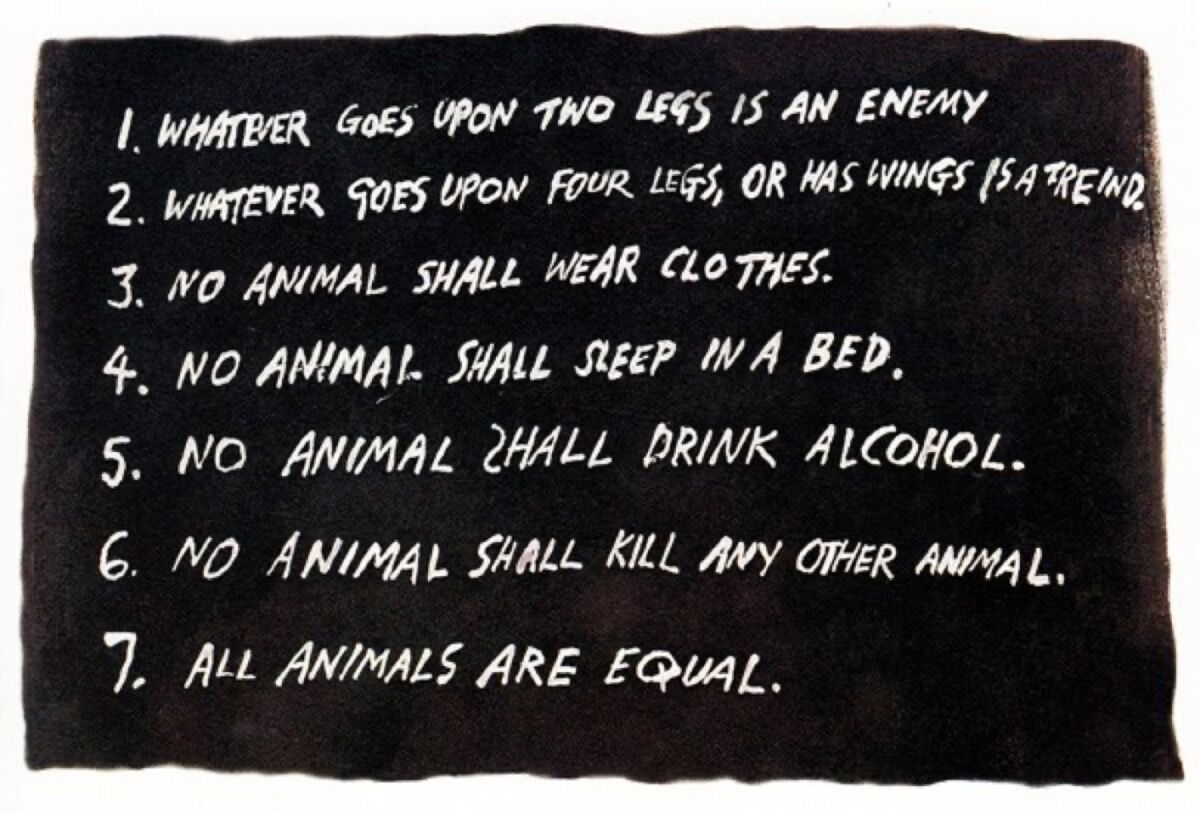
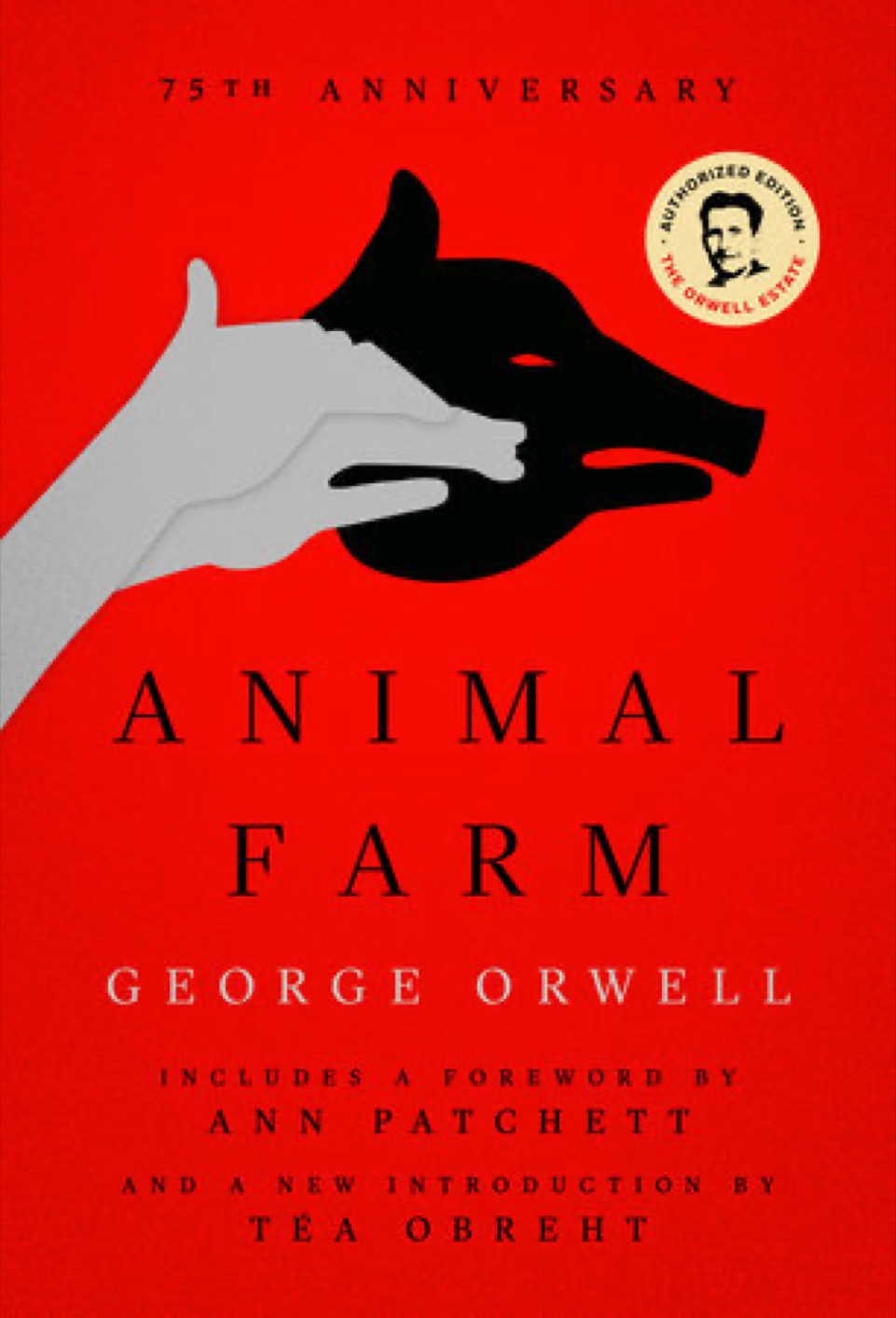
1. Whatever goes upon two legs is an enemy.
2. Whatever goes upon four legs, or has wings, is a friend.
3. No animal shall wear clothes.
4. No animal shall sleep in a bed.
5. No animal shall drink alcohol.
6. No animal shall kill any other animal.
7. All animals are equal.
Adler continues:
Now … Yerkes has discovered a fairly elaborate language in the possession of chimpanzees. Sure monkeys chatter to one another and chimpanzees are the highest form of monkeys and they chatter to one another. But what is this monkey chatter like?
What are the 125 so-called “words” that Professor Yerkes found in the language of chimpanzees? They are all emotional outcires, expression of need, of pain of pleasure, of rage, of hate, of hunger, of sex. Humans have such cries too. We say, “Oh, ah, ouch.” That is like the monkey’s cry.
But we also have a syntactical language. We, in thinking, make sentences. And in those sentences are words that are abstract, that refer to things that cannot be perceived, but only understood. Human language is the only language that is syntactical, has parts of speech and sentences.
3. Only Humans Associate Politically
I’ve got some bad news for those of you who hate politics: engaging in politics, according to Adler, is what makes us uniquely human (and that may also be the reason why animals are actually better than humans). Nevertheless, here’s what Adler writes:
Man is the only political animal. … All the other animals that are social or gregarious are so instinctively. The organization of the beehive, of the ant colony, of the termite colony, these are all instinctive organizations. They do not change from century to century, from generation to generation.
But humans form by reason the conventions, the constitutions, the laws, the rules unto which they live. And that is why in human families or in human states, political societies, there is such a great variability from tribe to tribe, culture to culture, epoch to epoch, century to century.
Adler concludes:
Man is the only animal who devises the constitutions and laws under which he lives. This is the evidence of his reason and freedom. In fact, instead of saying man is the only political animal, what I perhaps should say even more sharply here is that man is the only constitutional animal.
Complement with Erich Fromm on work, love, religion, and happiness and John Seed on going beyond anthropocentrism.

I’m a freelance writer with 6 years of experience in SEO blogging and article publishing. While you’re here, get the latest updates by subscribing to my newsletter.