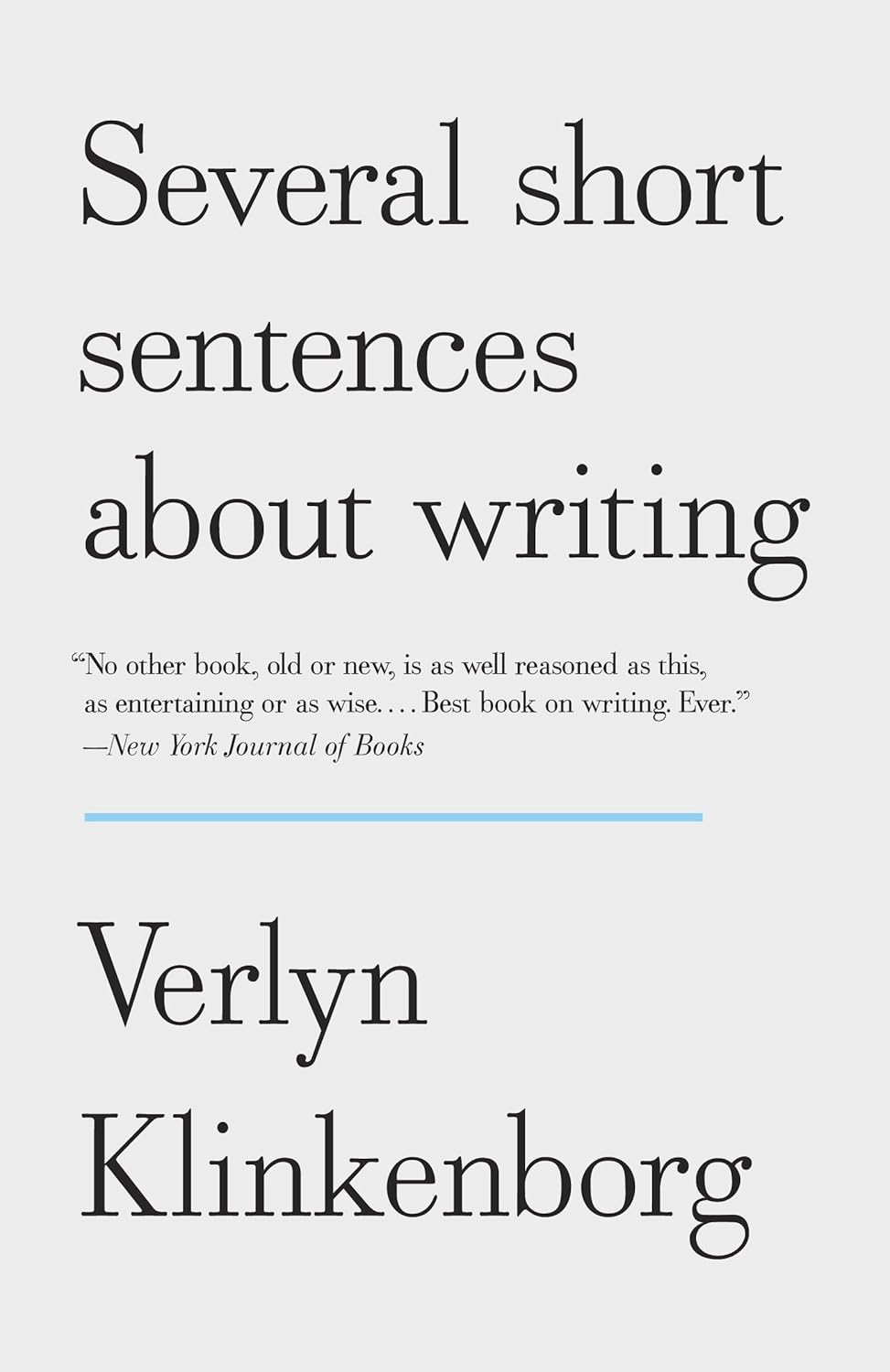
 Do you believe there’s a correlation between sentence length and the sophistication of an author’s idea or thought — even intelligence generally?
“There isn’t,” writes Verlyn Klinkenborg in his book “Several Short Sentences About Writing.” “You can say smart, interesting, complicated things using short sentences.”
In a sentiment that calls to mind George Orwell’s famous call to keep it short — “If it is possible to cut a word out, always cut it out,” he wrote — Klinkenborg adds:

Love reading and writing? Submit a post to our blog.
The fact that you’ve included a word in the sentence you’re making
Says nothing about its necessity.
See which words the sentence can live without,
No matter how inconspicuous they are.Every word is optional until it proves to be essential,
Something you can only determine by removing words one by one
And seeing what’s lost or gained.
Listen for the sentence that’s revealed as you remove on word after another.
You’ll hear the improvement when you find it.
He further clarifies:
Why short sentences?
They’ll sound strange for a while until you can hear what they’re capable of.
But they carry you back to a prose you can control,
To a stage in your education when your diction — your vocabulary — was under control too.
Short sentences make it easier to examine the properties of the sentence.
[…] They help eliminate transitions.
They make ambiguity less likely and easier to detect.There’s nothing wrong with well-made, strongly constructed, purposeful long sentences.
But long sentences often tend to collapse or break down or become opaque or trip over their awkwardness.They’re pasted together with false syntax
And rely on words like ‘with’ and ‘as’ to lengthen the sentence.
They’re short on verbs, weak in syntactic vigor,
Full of floating, unattached phrases, often out of position.
And worse — the end of the sentence commonly forgets its beginning,
As if the sentence were a long, weary road to the wrong place.Writing short sentences restores clarity, the directness of subject and verb.
[…] Writing short sentences will help you write strong, balanced sentences of any length.
Strong, lengthy sentences are really just strong, short sentences joined in various ways.
Charles Euchner continues this thought in his book “The Elements of Writing”:
Some writers rebel against the imperative of simple sentences. They say it robs them of the chance to develop their own style: If William Faulkner can make long sentences work, why can’t I?
Sure, Faulkner used meandering sentences to suggest the complexity of relationships and history and to evoke a Southern Gothic mood.
But wait. Before he broke away to create his own longform style, Faulkner mastered the fundamentals of simple sentence constructions. Like Picasso, who mastered representational work before inventing cubism, Faulkner knew how to do all the basics.
To support his claim, Euchner quotes a passage from William Faulkner’s “Light in August”:
They enter the kitchen together, though Mrs. Armstid is in front. She goes straight to the stove. Lena stands just within the door. Her head is uncovered now, her hair combed smooth. Even the blue garment looks freshened and rested.
She looks on while Mrs. Armstid at the stove clashes the metal lids and handles the sticks of wood with the abrupt savageness of a man. ‘I would like to help,’ Lena says.
Mrs. Armstid does not look around. She clashes the stove savagely. ‘You stay where you are. You keep off your feet now, and you’ll keep off your back awhile longer maybe.’
The young woman does not answer at once. Mrs. Armstid does not rattle the stove now, though her back is still toward the younger woman. Then she turns.
They look at one another, suddenly naked, watching one another: the young woman in the chair, with her neat hair and her inert hands upon her lap, and the older one beside the stove, turning, motionless too, with a savage screw of gray hair at the base of her skull and a face that might have been carved in sandstone. Then the younger one speaks.
Euchner concludes:
Faulkner’s 16 sentences total 196 words, an average of 12 and a half words per sentence. The passage uses 145 single-syllable words, 44 two-syllable words, and seven three-syllable words. Simplicity itself.
Even when he wrote longer sentences, Faulkner delivered a series of clear blasts. You never get confused about who’s doing or saying what to whom.
Faulkner mastered complexity. But before that, he mastered simplicity.
Complement with the Golden Rule of Writing, George Orwell’s six rules of writing, and then revisit Jack Kerouac, who urged us to “remove literary, grammatical and syntactical inhibition.”

I’m a freelance writer with 6 years of experience in SEO blogging and article publishing. While you’re here, get the latest updates by subscribing to my newsletter.