 In discussing the three cardinal virtues with Bill Moyers, philosopher Mortimer Adler (December 28, 1902–June 28, 2001) said that temperance and courage are self-regarding qualities: They order your life with respect to your own good.
Justice, however, orders your life with respect to the common good. And while it’s easy to see why the first two virtues serve you, it’s hard to see why you should be just when it primarily serves others rather than your own immediate desires.
Adler continues his thought in the book “How to Think About the Great Ideas” by focusing on the meaning of the word “justice.” He starts by noting that we often ask the wrong question:

Love reading and writing? Submit a post to our blog.
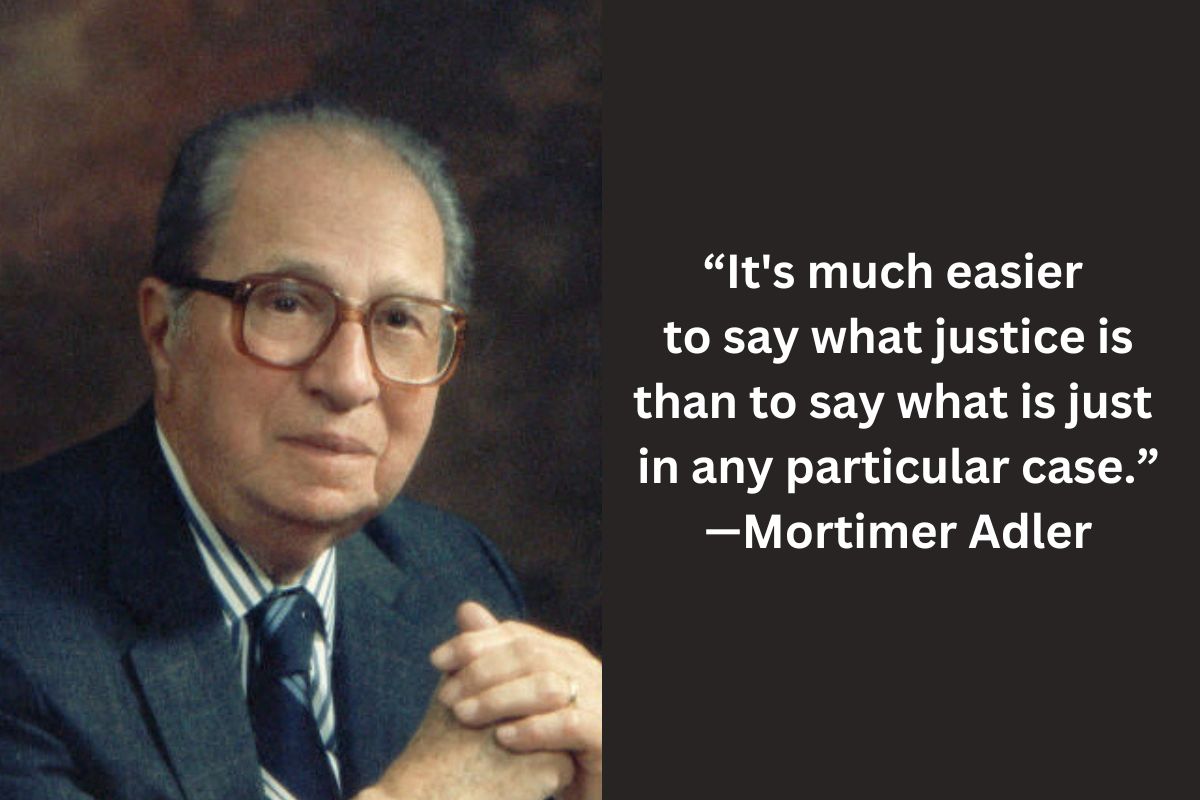
People often confuse two different questions. The question, What is justice? and the question, What is just in this case? I tend to think that it’s much easier to say what justice is than it is to say what in any particular case is a just handling of that case.
Adler adds that it’s not only the reason why people shy off such “big” and “difficult” words as “justice”:
The other reason is that they have a feeling that there are so many conflicting senses of the word. They have a general impression that in the history of European thought eminent philosophers have given quite different meanings and that in ordinary speech people use the “justice” with quite different meaning.

Then he goes on to define the three meanings of the word “justice,” noting that “different senses I’m going to enumerate for you are, I think, the senses in which you and I every day of our lives use the word ‘justice’ or the adjectives ‘just’ and ‘unjust’”:
1. Justice consists in treating equals equally and unequals unequally.
Suppose two persons commit the same crime, let the crime be petty larceny.
Is it just or unjust if one man is sentenced to three months’ imprisonment and the other to nine months’ imprisonment?
Supposing the crime and all the circumstances to be the same, I think our general sense is that the individuals having committed a crime of equal gravity, they should be punished with equal severity.
He gives another example:
But take the opposite case, one person has committed petty larceny and another person has committed grand larceny, involving in addition to that assault and battery.
Would it be just to give these two individuals, who have committed crimes of unequal gravity, the same punishment?
Or shouldn’t we punish more severely the one who has committed the graver offense?Now it is in this simple sense of equal treatment of equals and unequal treatment of unequals that I think we all use, almost every day of our lives, the words “just” and “unjust.”
2. Justice consists in rendering to each individual what he is due, giving to each person what belongs to him.
An individual who pays his debts is a just person because he owes the other individual something and he is giving another individual what belongs to him, whereas a person who steals is unjust, for he is taking from someone else what belongs to him.
And so we speak of a just government as one which respects and secures the natural rights of individuals. Why? Because what we mean by natural rights are the things that belong to a person and are proper to him.
And a government which does not give a person what is his due is unjust, whereas those governments which respect and secure the natural rights of human beings are therefore just.
3. Justice consists in obeying the laws of the community in which one lives.
We say that a person is just if he obeys the law of the community in which he lives. The just person is the law-abiding citizen; the criminal, the individual who breaks the law, is unjust.
But then he adds that there has to be “something behind the law, prior to the law, that determines whether or not men [and women] are acting justly when they are acting lawfully.”
To clarify his point, he turns to Artistotle, who distinguished between conventional justice and natural justice. For example, Adler notes, “there is nothing right or wrong about left hand driving as opposed to right hand driving” until the law is made. He explains:
For example, in all the communities in which you and I live, there are traffic laws. We are asked to stop at certain corners, drive at certain speeds, drive on the right or the left hand side of the road.
There is nothing just or unjust about any one of these things until the law is made. It is conventionally decided … by the legislator or by some commission….
Then the just person is one who obeys these laws simply because they are the statutes or ordinances of the community in which he lives.
[…]Yet even if there were no law made concerning stealing or murder, to kill a man or to take what belonged to him and not to you, would according to Aristotle be naturally unjust.
And so a law that prohibits murder or prohibits stealing is a law the justice of which is not conventional but natural.
He concludes:
Hence the measure of justice in the laws must be found, according to Aristotle, in a principle of natural justice.
For only in this way can we talk about the laws being just and unjust in a sense that is different from the way in which we speak of a person as being just or unjust when that person obeys the law.
“How to Think About the Great Ideas” is an excellent read in its entirety. Complement with Mortimer Adler on knowledge vs. opinion and the meaning of true virtue.

I’m a freelance writer with 6 years of experience in SEO blogging and article publishing. While you’re here, get the latest updates by subscribing to my newsletter.