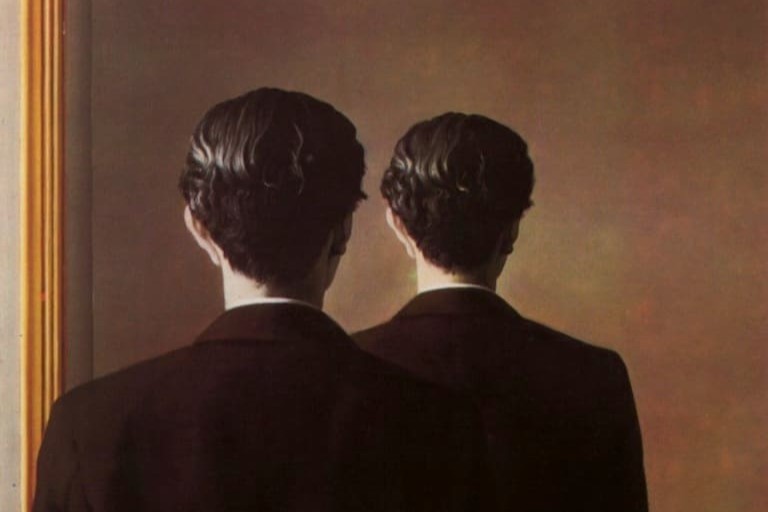
“The computer is a new mirror, the first psychological machine. Beyond its nature as an analytical engine lies its second nature as an evocative object,” Sherry Turkle wrote while contemplating the human spirit in a computer culture.
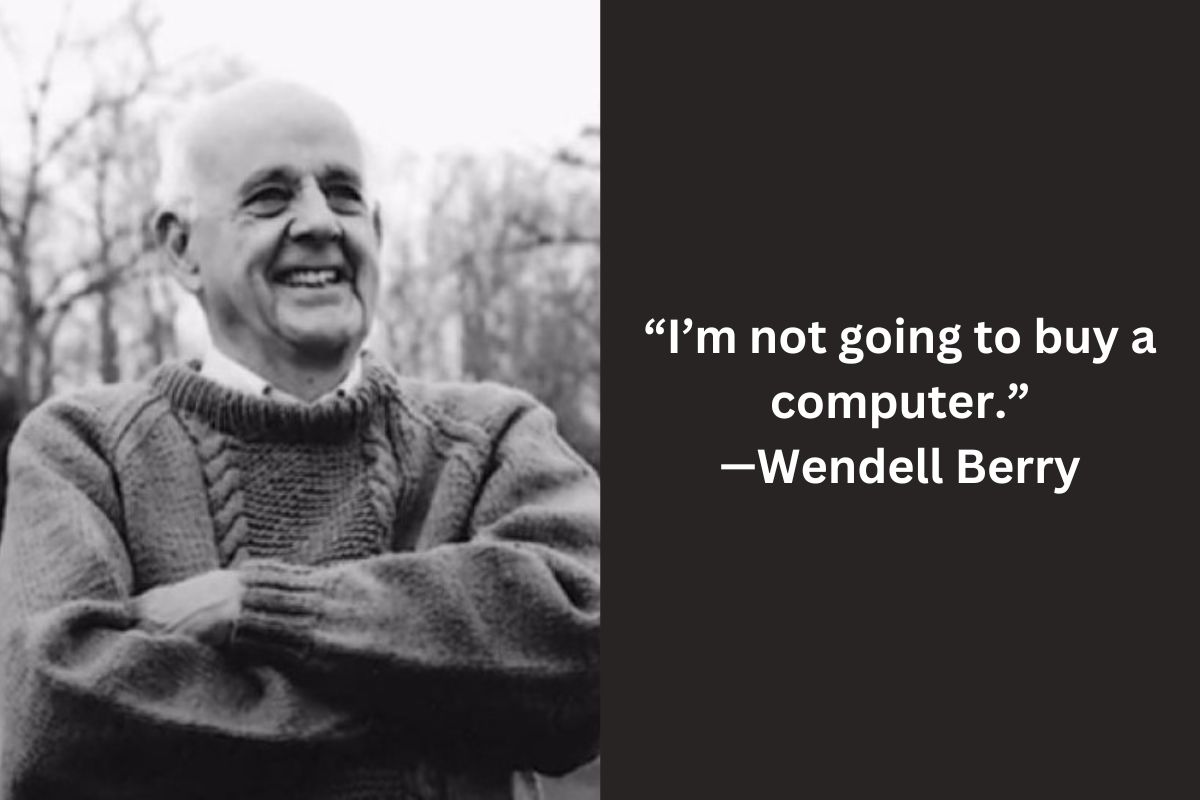
“I do not see that computers are bringing us one step nearer to anything that does matter to me: peace, economic justice, ecological health, political honesty, family and community stability, good work,” Wendell Berry wrote while contemplating the human spirit in a computer-less culture.
Yet I believe that the truth lies in-between these two opposing views. This is what we’ll explore in this selection of seven best Sherry Turkle books on human-computer relationship.
Love reading and writing? Submit a post to our blog.
Let’s dive in.
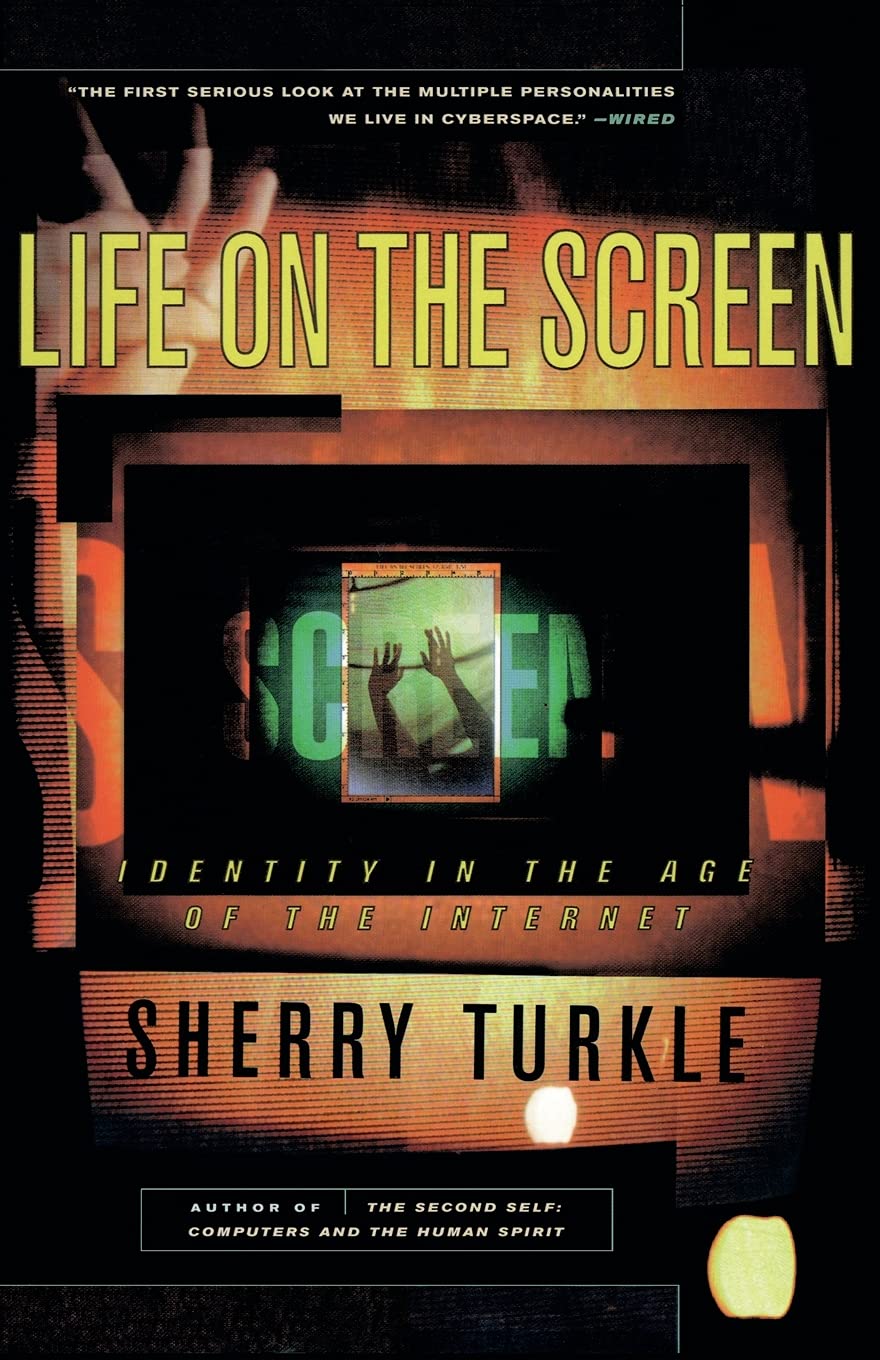
1. Life on the Screen: Identity in the Age of the Internet
“Life on the Screen” is a book not about computers, but about people and how computers are causing us to reevaluate our identities in the age of the Internet.
We are using life on the screen to engage in new ways of thinking about evolution, relationships, politics, sex, and the self.
Life on the Screen traces a set of boundary negotiations, telling the story of the changing impact of the computer on our psychological lives and our evolving ideas about minds, bodies, and machines.
What is emerging, Turkle says, is a new sense of identity—as decentered and multiple.
She describes trends in computer design, in artificial intelligence, and in people’s experiences of virtual environments that confirm a dramatic shift in our notions of self, other, machine, and world.
The computer emerges as an object that brings postmodernism down to earth.
2. The Second Self Computers and the Human Spirit
In “The Second Self,” Sherry Turkle looks at the computer not as a “tool,” but as part of our social and psychological lives; she looks beyond how we use computer games and spreadsheets to explore how the computer affects our awareness of ourselves, of one another, and of our relationship with the world.
[…]Turkle talks to children, college students, engineers, AI scientists, hackers, and personal computer owners—people confronting machines that seem to think and at the same time suggest a new way for us to think—about human thought, emotion, memory, and understanding.
Her interviews reveal that we experience computers as being on the border between inanimate and animate, as both an extension of the self and part of the external world.
[…]Why we think of the workings of a machine in psychological terms—how this happens, and what it means for all of us—is the ever more timely subject of “The Second Self.”
3. Alone Together: Why We Expect More from Technology and Less from Each Other
Technology has become the architect of our intimacies.
Online, we fall prey to the illusion of companionship, gathering thousands of Twitter and Facebook friends, and confusing tweets and wall posts with authentic communication.
But this relentless connection leads to a deep solitude.
MIT professor Sherry Turkle argues that as technology ramps up, our emotional lives ramp down.
Based on hundreds of interviews and with a new introduction taking us to the present day, “Alone Together” describes changing, unsettling relationships between friends, lovers, and families.
4. Falling for Science: Objects in Mind
In “Falling for Science,” distinguished scientists, engineers, and designers as well as twenty-five years of MIT students describe how objects encountered in childhood became part of the fabric of their scientific selves.
[…]The senior scientists’ essays trace the arc of a life: the gears of a toy car introduce the chain of cause and effect to artificial intelligence pioneer Seymour Papert; microscopes disclose the mystery of how things work to MIT President and neuroanatomist Susan Hockfield; architect Moshe Safdie describes how his boyhood fascination with steps, terraces, and the wax hexagons of beehives lead him to a life immersed in the complexities of design.
The student essays tell stories that echo these narratives: plastic eggs in an Easter basket reveal the power of centripetal force; experiments with baking illuminate the geology of planets; LEGO bricks model worlds, carefully engineered and colonized.
All of these voices—students and mentors—testify to the power of objects to awaken and inform young scientific minds. This is a truth that is simple, intuitive, and easily overlooked.
5. Evocative Objects: Things We Think With
Autobiographical essays, framed by two interpretive essays by the editor, describe the power of an object to evoke emotion and provoke thought….
In “Evocative Objects,” Turkle collects writings by scientists, humanists, artists, and designers that trace the power of everyday things.
[…]Whether it’s a student’s beloved 1964 Ford Falcon (left behind for a station wagon and motherhood), or a cello that inspires a meditation on fatherhood, the intimate objects in this collection are used to reflect on larger themes—the role of objects in design and play, discipline and desire, history and exchange, mourning and memory, transition and passage, meditation and new vision.
In the interest of enriching these connections, Turkle pairs each autobiographical essay with a text from philosophy, history, literature, or theory, creating juxtapositions at once playful and profound.
[…]Essays by Turkle begin and end the collection, inviting us to look more closely at the everyday objects of our lives, the familiar objects that drive our routines, hold our affections, and open out our world in unexpected ways.
6. The Inner History of Devices
In “The Inner History of Devices,” Sherry Turkle describes her process, an approach that reveals how [technology] is woven into our ways of seeing ourselves.
[…]One personal computer owner tells Turkle: “This computer means everything to me. It’s where I put my hope.”
Turkle explains that she began that conversation thinking she would learn how people put computers to work.
By its end, her question has changed: “What was there about personal computers that offered such deep connection? What did a computer have that offered hope?”
“The Inner History of Devices” teaches us to listen for the answer.
In the memoirs, ethnographies, and clinical cases collected in this volume, we read about an American student who comes to terms with her conflicting identities as she contemplates a cell phone she used in Japan (“Tokyo sat trapped inside it”);
a troubled patient who uses email both to criticize her therapist and to be reassured by her;
a compulsive gambler who does not want to win steadily at video poker because a pattern of losing and winning keeps her more connected to the body of the machine.
In these writings, we hear untold stories. We learn that received wisdom never goes far enough.
7. Reclaiming Conversation: The Power of Talk in a Digital Age
We live in a technological universe in which we are always communicating. And yet we have sacrificed conversation for mere connection.
[…]In “Reclaiming Conversation: The Power of Talk in a Digital Age,” Sherry Turkle investigates a troubling consequence:
The dinner table falls silent as children compete with phones for their parents’ attention.
Friends learn strategies to keep conversations going when only a few people are looking up from their phones.
At work, we retreat to our screens although it is conversation at the water cooler that increases not only productivity but commitment to work.
Online, we only want to share opinions that our followers will agree with – a politics that shies away from the real conflicts and solutions of the public square.
[…]But there is good news: we are resilient. Conversation cures.
[…]We have everything we need to start, we have each other.
Complement this list of best Sherry Turkle books on human-computer relationship with our article on the most important skill in the age of AI and then try to answer this question: “Can you really tell if a sentence was written by artificial intelligence?”

I’m a freelance writer with 6 years of experience in SEO blogging and article publishing. While you’re here, get the latest updates by subscribing to my newsletter.